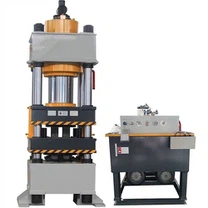
Grundparameter der hydraulischen Presse
Die Grundparameter sind die technischen Grunddaten der hydraulischen Presse, die sich nach der technologischen Nutzung und dem Aufbautyp der hydraulischen Presse richten. Es spiegelt die Arbeitskapazität und die Eigenschaften der hydraulischen Presse wider und bestimmt auch im Wesentlichen die Umrissgröße und das Gesamtbruttogewicht der hydraulischen Presse. Die Grundparameter werden vom Benutzer ausgewählt. Die wichtigste Grundlage für den Einkauf. Was sind also die Grundparameter der hydraulischen Presse? Wie kann man die Parameter der hydraulischen Presse verstehen und auswählen? Heute werde ich die grundlegenden Parameter der üblichen hydraulischen Presse mit drei-Balken und vier-Säulen für Sie sortieren.
1. Nennkraft (KN)
The nominal force is generally the main parameter of the hydraulic press, which reflects the working capacity of the hydraulic press. The nominal force is the maximum working pressure that the hydraulic press can nominally issue, and is numerically equal to the product of the maximum liquid pressure and the total area of the working plunger (piston radius) R²πpressure gauge value (system pressure)
Note: 1MPa≈100N
Take 60T calculation as an example: cylinder diameter φ180mm system pressure 25MPa (for high pressure)
90903.1425÷10000 (unit conversion)
2. Maximale Kopffreiheit (Öffnungshöhe)
The maximum clearance distance refers to the distance from the upper surface of the table to the lower surface of the movable beam when the movable beam stops at the upper limit position. The maximum clearance distance reflects the size of the working space of the hydraulic press in the height direction. It should be determined by process factors such as the height of the mold and the corresponding backing plate, the size of the working stroke, and the size of the space required for placing the blank and taking out the workpiece. The maximum clearance has a great influence on the overall height of the hydraulic press, the length of the column, the stability of the hydraulic press body and the height of the installation workshop. The maximum clearance distance of the single-arm hydraulic press is the distance from the lower plane of the indenter to the upper surface of the table.
3. Maximaler Hub
The maximum stroke refers to the distance from the lower plane of the column guide sleeve of the movable beam to the upper plane of the column travel limit sleeve when the movable beam is at the upper limit position, that is, the maximum distance that the movable beam can move. The maximum stroke should be determined according to the required maximum working stroke during the workpiece forming process.
4. Tischgröße (Länge Breite)
The workbench is generally the place where the mold is placed. The size of the worktable refers to the effective size that can be used on the worktable, and the size of the worktable depends on the plane size of the mold and the arrangement of the process.
5. Ausladung (hydraulische Einsäulenpresse)
Refers to the distance from the center of the single-column hydraulic press head to the inner surface of the frame.
6. Rückstellkraft
The return force refers to the weight of the movable part, the force required for the return process (such as the draft force, the lifting force of the chopping knife), etc.
7. Bewegungsgeschwindigkeit des beweglichen Balkens (Schiebergeschwindigkeit): Sie kann in Arbeitshubgeschwindigkeit, Leerlaufhubgeschwindigkeit (Flüssigkeitsfüllhub) und Rückhubgeschwindigkeit unterteilt werden.
The idle travel and return travel can generally be higher to improve productivity, but too fast will cause shock and vibration when stopping or reversing.
Es gibt drei Arten von Geschwindigkeit:
⑴Constant speed (eternal speed): rising speed, falling speed (using electro-hydraulic reversing valve)
⑵Differential: ①Fast down, slow back ②Slow down, fast back, idle descending, pressing, and returning (with cartridge valve) ③Up and down equal velocity
(3) Schnell (Flüssigkeitsfüllsystem): Es ist auch absichtlich mit einem Zylinder ausgestattet, der die Geschwindigkeit- erhöht, anstatt sich auf sein eigenes Gewicht zu verlassen, um zu fallen;
8. Nennausstoßkraft und Ausstoßhub
The function of the ejector cylinder is to eject or stretch, and the power and stroke safety of the ejector are determined by the process requirements;
9. Die einfachwirkende-hydraulische Presse zum Strecken von Blechen Y27 muss auch die Parameter der hydraulischen Stempelkraft und des hydraulischen Stempelhubs kennen.
10. Die hydraulische Y28-Doppelwirkungs-Blattziehpresse muss auch die Parameter der Ziehkraft, der Blechhalterkraft, des Hubs des Ziehschiebers, des Hubs des Blechhalters und der Öffnungshöhe kennen Ziehschieber und die Öffnungshöhe des Niederhalters.
11. Ob es sich bei der hydraulischen Einsäulenpresse- um einen Spannfuttertyp oder eine Struktur mit oberem Schieber (Pressplattentyp) handelt, ob es notwendig ist, den Arbeitstisch zu korrigieren usw.
12. Handlungsablauf (Aktionsprozess) Der Kunde stellt den Pressprozessablauf und Prozessanforderungen (Prozessanforderungen) zur Verfügung.